Choppa Tools
For years, pneumatic impact wrenches dominated repair bays, assembly lines, and heavy equipment workshops. Their steady torque came from compressed air, not battery charge. Yet the worksite is changing. Technicians now move between vehicles, rooftops, and remote service locations. Carrying a hose and compressor can slow that movement.
So, why are cordless impact wrenches becoming more popular than pneumatic tools? The answer is not simply “more power.” Modern brushless motors deliver strong breakaway torque in compact bodies. High-capacity batteries also support longer shifts than earlier models. There is no compressor noise. No tangled airline. Just a charged pack and a trigger.
Kenny Koehler, an experienced power-tool reviewer and editor, describes the practical shift this way: “Cordless tools have become a serious alternative when mobility and setup time matter more than continuous air supply.” His point reflects workshop reality. A mechanic can grab a wrench from a service cart and reach a wheel assembly immediately. That saved minute matters across dozens of jobs.
Still, cordless tools are not perfect. Heavy fastening can drain batteries quickly. Heat may build inside the motor. Pneumatic models often remain better for nonstop production work. This is where the discussion becomes less tidy. The best choice depends on duty cycle, torque accuracy, maintenance habits, and available infrastructure.
The replacement is gradual.
Cordless impact wrenches are winning because they fit modern workflows. They reduce equipment dependency while preserving useful performance. In some workshops, that balance is convincing. In others, compressed air still earns its place.
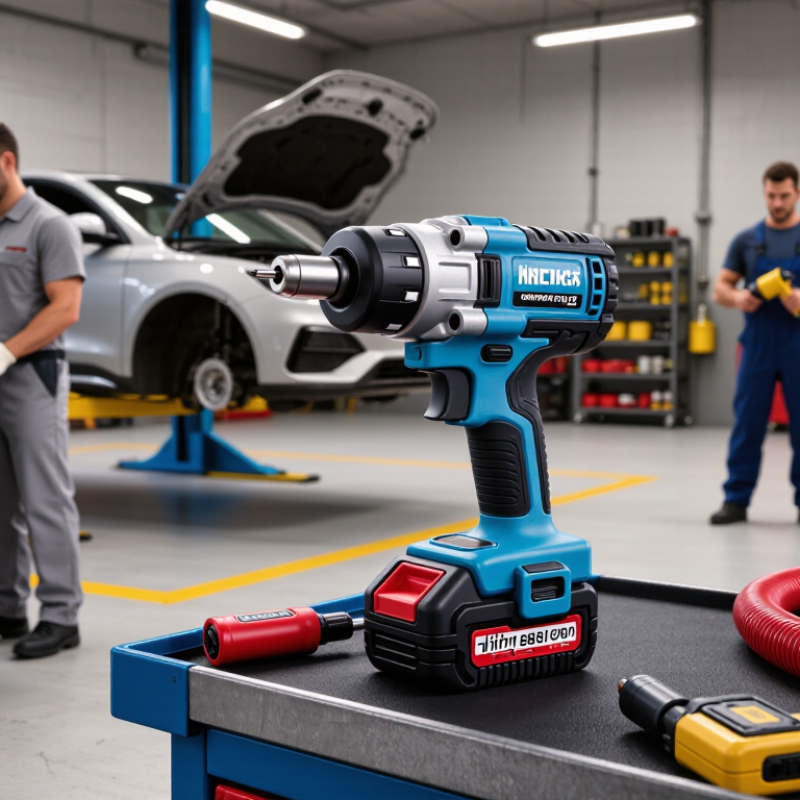
A cordless impact wrench converts stored battery energy into repeated rotational impacts. That process explains its growing use beside vehicles, machinery, and construction frames. When I squeeze the trigger, electronic controls regulate current before the motor accelerates. The motor spins a shaft through reduction gears, which trade speed for turning force. At the nose, a hammer mechanism builds momentum and strikes the anvil when resistance rises. Short impacts. Those pulses loosen stubborn fasteners without requiring a continuous twisting force. No air plumbing.
In practical use, the trigger feels more responsive than I first expected. Light pressure can seat a nut, while full pressure delivers stronger impacts. Several tools offer speed settings, reverse control, and automatic shutoff modes. These features help reduce overtightening, although they do not replace measurement. Battery temperature also matters. Repeated heavy impacts warm the pack and may reduce output temporarily. I once blamed the mechanism for weak performance, then noticed a nearly empty battery. That was a useful mistake.
Compared with pneumatic equipment, the cordless design removes compressor noise, hoses, and pressure losses. It also works where dragging an air line would slow a repair. Yet it is not automatically better. A large fastener can drain a battery quickly, and compact tools may struggle with seized hardware. Torque ratings can vary with testing conditions, socket fit, and battery charge. For critical joints, I use the impact wrench for removal or snugging. Then I verify final torque with a calibrated torque wrench. That extra step feels slower, but it protects the thread and the assembly.
Cordless impact wrenches use a rechargeable battery to power an electronic controller and brushless motor. The motor drives reduction gears, which rotate a hammer mechanism that delivers repeated impacts to the anvil. This removes the need for an air compressor, hose, and fixed air lines while providing comparable torque and impact rates in many professional applications.
Values shown are representative midpoints of commonly published professional-tool specifications; actual performance varies by tool size, battery capacity, air pressure, and operating conditions.
Why Are Cordless Impact Wrenches Replacing Pneumatic Tools?
The key difference is the power source. A cordless impact wrench uses a battery, motor, and electronic control system. A pneumatic tool depends on an air compressor, hose, fittings, and stable pressure. That setup can deliver excellent durability. However, it also limits movement around vehicles, machinery, and elevated work areas.
The U.S. Department of Energy reports that compressed-air systems may consume about 10% of industrial electricity. It also notes that leaks can waste 20–30% of compressor output in poorly maintained systems. Cordless tools remove these losses at the point of use. They start instantly and reduce hose-related trip hazards. Grand View Research valued the global cordless power tools market at about $21.8 billion in 2023. Its report projects strong growth through 2030. Still, batteries add charging time, weight, and replacement costs. High-torque work can drain a pack quickly. That comparison is not clean. Pneumatic tools may remain better for continuous production cycles.
Tips: Check the required torque, fastening speed, and daily duty cycle. Use a calibrated torque tester, not only the tool’s display. Keep spare batteries ready. Store them away from heat and moisture. Inspect pneumatic hoses for leaks before blaming the tool. A careless comparison can produce the wrong purchase.
Cordless impact wrenches are replacing pneumatic tools because battery and motor technology have improved together. The change is visible on busy service floors, where hoses once crossed every walkway. Brushless motors now deliver higher efficiency, longer service life, and more consistent torque. Electronic controls can also limit over-tightening, a practical improvement for assembly work.
Battery progress is accelerating this shift. BloombergNEF’s 2024 Battery Price Survey reported an average lithium-ion pack price of 115 dollars per kilowatt-hour. That figure fell 20% from 2023. Lower cell costs support larger packs without making tools excessively heavy. Thermal sensors and improved charging systems also reduce performance drops during repeated fastening. Still, battery weight remains a real trade-off. The newest tool is not always the best tool.
Pneumatic equipment has hidden operating costs. The U.S. Department of Energy reports that compressed-air leaks can waste 20–30% of compressor output. Eliminating hoses, compressors, and leak inspections can simplify a work cell. Cordless tools also improve mobility around vehicles, elevated platforms, and remote maintenance areas. Field evaluations should measure torque accuracy, cycle time, battery changes, and operator fatigue. Marketing claims often focus on peak torque. That is only one part of productivity. A tool may reach impressive torque briefly, yet perform poorly under heat or continuous use. Careful testing still matters.
Why Are Cordless Impact Wrenches Replacing Pneumatic Tools?
In busy workshops, cordless impact wrenches remove hoses, compressors, and awkward cable routes. A technician can carry one tool between a service bay, loading area, and maintenance platform. That mobility saves setup time, especially when repairs happen far from fixed air lines. The improvement feels practical, not dramatic. Less equipment surrounds the job.
Battery technology is also supporting this shift. BloombergNEF’s 2023 Battery Price Survey reported an average lithium-ion pack price of 139 dollars per kilowatt-hour, a 14% year-on-year decline. Lower battery costs can make professional cordless equipment easier to justify across larger teams. However, battery runtime still depends on torque, temperature, and workload. Charging discipline matters.
Safety benefits deserve careful attention. The UK Health and Safety Executive identifies 2.5 m/s² A(8) as the hand-arm vibration action value and 5.0 m/s² as the exposure limit. A cordless tool does not automatically reduce vibration exposure. Operators must review measured values, use suitable sockets, and rotate demanding tasks. Weight can also create wrist fatigue during overhead work. That trade-off is easy to overlook. In my view, the strongest workplace advantage is controlled access: fewer hoses underfoot, faster tool movement, and no compressor noise during every task. Yet battery inspection, charging areas, and spare packs become new responsibilities. The technology is cleaner operationally, but not maintenance-free.
| Evaluation Dimension | Cordless Impact Wrench | Pneumatic Impact Wrench | Workplace Benefit or Trade-Off |
|---|---|---|---|
| Primary Power Source | Rechargeable lithium-ion battery, commonly 12–36 V depending on the tool class. | Compressed air supplied through an air hose and compressor system. | Cordless tools remove the need for a dedicated air line at the point of use. |
| Typical Operating Pressure | Not applicable at the tool; electrical energy is converted directly into mechanical output. | Usually approximately 90–120 psi (6.2–8.3 bar), subject to the tool and installation requirements. | Cordless operation avoids pressure losses caused by undersized hoses, leaks, or inadequate compressor capacity. |
| Mobility | High mobility; the operator is not connected to a hose or fixed air outlet during use. | Limited by hose length, hose routing, couplings, and the location of the air supply. | Battery-powered tools are advantageous on assembly lines, service vehicles, elevated work areas, and outdoor sites. |
| Setup Time | Normally limited to inserting a charged battery and selecting the required operating mode. | May require compressor start-up, hose connection, regulator adjustment, and leak checks. | Reduced preparation time can support faster changeovers and maintenance tasks. |
| Torque Capability | Available across a broad range, from compact fastening applications to heavy-duty outputs above 1,000 N·m, depending on tool design. | Also available from low-torque assembly tools to heavy-duty outputs above 1,000 N·m. | Both technologies can meet many industrial fastening requirements; selection should be based on the required torque range and joint specification. |
| Torque Control | Electronic speed, torque, and fastening modes are available on many models; final joint verification may still be required. | Torque is affected by air pressure, airflow, hose condition, lubrication, and regulator settings. | Electronic settings can improve repeatability, but neither tool type replaces calibrated torque measurement where standards require verification. |
| Noise and Air Exhaust | No compressed-air exhaust at the tool; mechanical impact noise remains and hearing protection may still be necessary. | Produces mechanical impact noise plus exhaust-air noise; the compressor can add background noise. | Cordless tools can reduce workplace noise sources, although an occupational noise assessment is still required. |
| Maintenance Requirements | Battery charging, inspection of the tool and battery, cleaning, and periodic mechanical servicing. | Tool lubrication, hose and coupling inspection, filter and regulator maintenance, condensate removal, and compressor servicing. | Cordless systems can reduce compressed-air infrastructure maintenance, but batteries require controlled storage, charging, and replacement procedures. |
| Energy Use at the Workstation | Uses stored electrical energy only when the tool is operating. | Requires energy for compression, air treatment, distribution, and leakage control in addition to tool operation. | Eliminating local compressed-air distribution can reduce energy losses, particularly where air demand is intermittent. |
| Downtime Management | Requires charged spare batteries, charging stations, or planned charging intervals for extended shifts. | Can support continuous operation when the compressor and air distribution system are correctly sized and maintained. | Cordless tools offer flexible deployment, while pneumatic systems may be better suited to very high-duty-cycle workstations. |
| Operator Ergonomics | No hose drag or hose snagging; the battery adds weight and can affect balance. | Often lighter as a tool body, but the hose can create pull, trip, or snag hazards. | The better option depends on tool balance, fastening frequency, posture, access, and the weight of the battery or hose. |
| Safety Considerations | Requires battery inspection, correct charging practices, protection from physical damage, and control of stored electrical energy. | Requires hose restraint, protection against accidental disconnection, pressure control, and safe compressor operation. | Cordless tools remove hose-related hazards but introduce battery-management requirements; risk assessment remains essential. |
| Best-Fit Applications | Mobile maintenance, field service, construction, vehicle repair, temporary work areas, and flexible assembly cells. | Fixed production stations, continuous high-volume fastening, and facilities with an established compressed-air network. | Cordless tools are replacing pneumatic tools mainly where mobility, quick setup, reduced infrastructure, and flexible deployment are priorities. |
Professional users are not choosing cordless impact wrenches simply for convenience. They are weighing mobility against battery limits, tool weight, and torque consistency. On a busy service floor, removing an air hose saves several seconds at each workstation. It also reduces trip hazards around lifts and crowded benches. However, a cordless tool can feel tiring after repeated overhead work. Battery mass changes the balance. That detail is easy to underestimate.
Selection should begin with the application, not the advertised torque figure. Check the required fastening range, duty cycle, socket size, and access space. A compact tool may fit inside a machinery frame, while a larger model may deliver stronger breakaway performance. Professionals should also examine speed control, trigger response, vibration, and the clarity of torque settings. For critical joints, final tightening may still require a calibrated torque wrench. Impact tools are not automatically precision instruments.
Battery capacity matters, but runtime depends on temperature, fastener resistance, and operator habits. Keep a spare battery available. That is practical, not excessive. Users working outdoors should inspect sealing against dust and moisture, while workshop teams should consider charging space and battery replacement costs. Pneumatic tools remain valuable where continuous operation and low tool weight matter most. Cordless equipment may be the better choice, yet it is not maintenance-free. I have seen users blame the tool after using worn sockets, weak batteries, or unsuitable settings. The uncomfortable truth is that selection errors often look like tool failure.
Cordless models use batteries, motors, and electronic controls. Pneumatic models require compressors, hoses, fittings, and stable air pressure.
They remove long hoses from walkways and work areas. Operators can move more freely around vehicles, platforms, and machinery.
No. Cordless tools suit mobile tasks, but pneumatic tools may perform better during continuous production cycles.
Compressors use substantial electricity, while air leaks waste output. Hose inspections, fittings, and maintenance also add daily work.
Newer battery packs provide more energy with less added weight. Better charging systems and thermal sensors support repeated fastening.
Batteries add weight, charging time, and replacement costs. High-torque work can drain a pack quickly. That trade-off matters.
Check torque, fastening speed, daily workload, battery changes, and operator fatigue. Test real cycles, not only peak torque claims.
Not always. Use a calibrated torque tester, because the screen may not reflect actual fastening results.
Keep spare batteries away from heat and moisture. Charge them with suitable equipment and inspect them before demanding work.
Comparing only headline torque can mislead buyers. A tool may reach high torque briefly, then struggle under heat or constant use.
Cordless impact wrenches are increasingly replacing pneumatic tools because they combine powerful fastening performance with greater mobility and convenience. Using a rechargeable battery, brushless motor, electronic controls, and a geared impact mechanism, these tools deliver high torque without requiring an air compressor, hose, or fixed workstation. The key difference is that pneumatic models depend on a continuous compressed-air supply, while cordless versions operate independently and are easier to carry between work areas.
Several advances are driving adoption, including higher-capacity batteries, faster charging, improved motor efficiency, better thermal management, and more precise torque and speed controls. In the workplace, cordless impact wrenches can reduce setup time, clutter, noise, and maintenance while improving productivity in construction, maintenance, assembly, and repair tasks. However, professional users must consider battery runtime, charging availability, tool weight, torque consistency, durability, and operating costs. Ultimately, why are cordless impact wrenches becoming more popular than pneumatic comes down to their balance of portability, performance, flexibility, and reduced dependence on centralized equipment.
