 Choppa Tools
Choppa Tools
Choppa Tools
Replacing a bearing is not simply a matter of matching a familiar number. The wrong size can create noise, heat, vibration, and early failure. This guide explains how to measure bearing size for replacement, using practical workshop methods and recognized engineering references.
Recent market studies from Grand View Research and Fortune Business Insights describe steady global demand for replacement bearings. Their findings reflect growing maintenance needs across motors, pumps, conveyors, vehicles, and industrial machinery. China remains a major manufacturing center, but production quality can vary between suppliers. That matters.
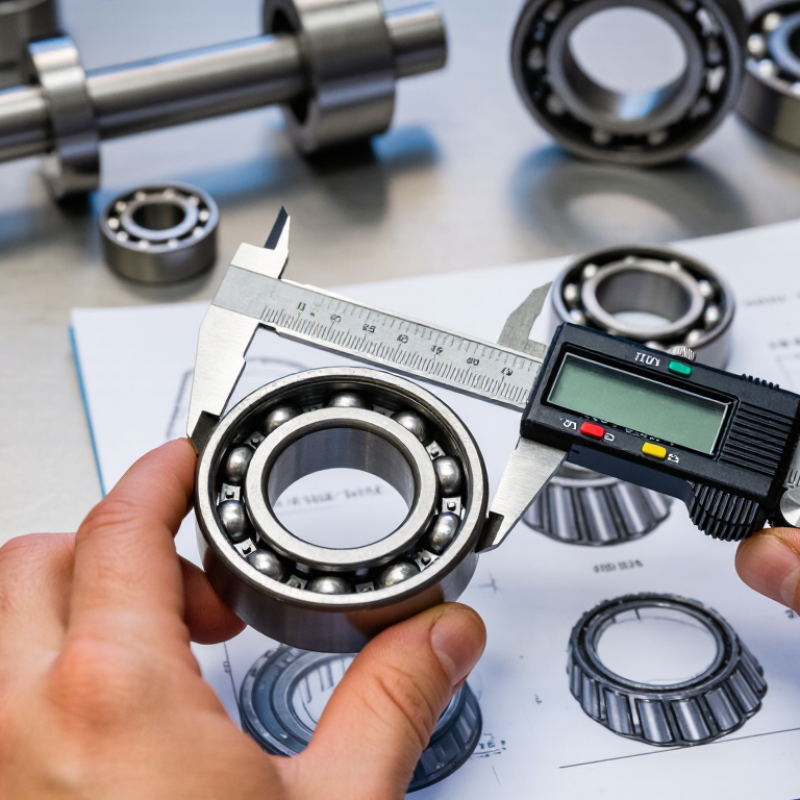
Start with three basic dimensions: bore diameter, outside diameter, and bearing width. Measure the inner ring with a calibrated micrometer. Check the outside ring with a vernier caliper. Measure width without squeezing the seals. Record each value in millimeters. A bearing marked 6205 commonly indicates a 25 mm bore, 52 mm outside diameter, and 15 mm width, according to standard manufacturer catalogs.
Do not trust appearance alone.
ISO 15 provides dimensional guidance for radial rolling bearings, while ISO 5593 defines important bearing terminology. These references support clearer communication with Chinese manufacturers and distributors. However, dimensions are only part of the decision. Check load ratings, speed limits, sealing type, internal clearance, and material. A motor may require C3 clearance, while a slow conveyor may not.
SKF, NSK, NTN, and Timken technical catalogs offer useful selection data and inspection guidance. Still, catalog information cannot replace measuring the original housing and shaft. I have seen replacements fail because buyers copied a worn bearing’s distorted dimensions. Recheck the shaft, housing fit, and application conditions before ordering.
China Best Bearings: How to Measure Size for Replacement?
Identify the bearing type before measuring its dimensions. A deep-groove ball bearing differs from a tapered roller or thrust bearing. Remove the old unit and inspect its marking, seal design, and row arrangement. Then measure the bore diameter, outside diameter, and overall width with a calibrated digital caliper. Record them as d, D, and B. ISO 15:2017 provides standardized boundary dimensions for many rolling bearings, but not every special design follows common tables.
Size alone cannot confirm a suitable replacement. Check the load direction, operating speed, shaft fit, housing fit, temperature, lubrication, and internal clearance. A motor application may require C3 clearance, while a precision spindle may need tighter control. ISO 281:2007 calculates basic rating life from dynamic load capacity and applied load. The U.S. Department of Energy reports that motor-driven systems consume about 23% of electricity in the United States, making correct bearing selection an important efficiency decision.
Do not rely on appearance. Measure twice. A worn raceway can distort the original dimensions, especially after overheating. Compare the measurements with the manufacturer-neutral ISO designation system and request material, hardness, clearance, and inspection records from the supplier. In practical replacement work, seal friction is often overlooked. That mistake can increase temperature and reduce service life. My checklist is useful, but imperfect; unusual loads still require an engineer’s review.
| Bearing Type | Typical Standard Example | Key Measurements to Take | Example Dimensions | Identification Features | Replacement Requirements | Important Inspection Points |
|---|---|---|---|---|---|---|
| Deep Groove Ball Bearing | 6204 | Bore diameter Outside diameter Width | 20 × 47 × 14 mm | Single-row bearing with deep raceway grooves; commonly used for radial and moderate axial loads. | Match the bore, outside diameter, width, seal or shield arrangement, internal clearance, and precision grade. | Check for rough rotation, noise, discoloration, pitting, corrosion, and excessive radial play. |
| Deep Groove Ball Bearing | 6205 | Bore diameter Outside diameter Width | 25 × 52 × 15 mm | Often fitted with open, shielded, or contact-sealed configurations. | Confirm whether the replacement requires open, metal-shielded, or rubber-sealed construction and verify the operating temperature range. | Inspect the shaft and housing fits before installation; worn fits can cause vibration and premature failure. |
| Deep Groove Ball Bearing | 6206 | Bore diameter Outside diameter Width | 30 × 62 × 16 mm | Suitable for combined radial and axial loads within the bearing's rated limits. | Match the exact dimensional series and select the appropriate internal clearance, such as normal clearance or increased clearance for heat or interference fits. | Measure the housing bore and shaft journal for wear, ovality, burrs, and damage. |
| Angular Contact Ball Bearing | 7205 | Bore diameter Outside diameter Width Contact angle | 25 × 52 × 15 mm | Shoulder arrangement supports axial load primarily in one direction; commonly used in pairs or sets. | Match the contact angle, mounting arrangement, preload, and pair configuration. Do not replace it with a standard deep groove bearing solely because the dimensions match. | Check the original mounting direction, preload marks, spacer dimensions, and shaft runout. |
| Tapered Roller Bearing | 30205 | Cone bore Cup outside diameter Overall width Flange dimensions | 25 mm bore; 52 mm cup diameter; approximately 16.25 mm overall width | Separate cone and cup components; rollers are arranged at an angle to support combined radial and axial loads. | Replace the cone and cup as a matched set. Set the correct endplay or preload according to the equipment specification. | Inspect both raceways and rollers for brinelling, spalling, scoring, overheating, and uneven wear. |
| Spherical Roller Bearing | 22210 | Bore diameter Outside diameter Width Internal clearance | 50 × 90 × 23 mm | Two rows of barrel-shaped rollers with a spherical outer raceway; accommodates misalignment and heavy loads. | Match the bore, outside diameter, width, clearance class, cage design, lubrication method, and mounting sleeve requirements. | Check shaft alignment, adapter sleeve condition, locking method, and signs of cage or roller damage. |
| Thrust Ball Bearing | 51105 | Bore diameter Outside diameter Height | 25 × 42 × 11 mm | Designed mainly for axial loads; not suitable for significant radial loading or shaft misalignment. | Confirm the load direction, rotating washer arrangement, axial capacity, lubrication, and seating surfaces. | Inspect washer raceways for grooves, indentations, overheating, and uneven contact marks. |
| Needle Roller Bearing | HK series example | Bore diameter Outside diameter Width Housing hardness | Must be measured from the installed bearing or technical drawing | Uses long, slender rollers with a small radial cross-section; may use a drawn cup or a machined raceway. | Verify whether the shaft acts as the inner raceway, and confirm shaft hardness, surface finish, lubrication, and axial retention. | Measure the shaft raceway for wear and check the housing for distortion, looseness, and improper press-fit damage. |
| Insert Bearing with Housing | UC-style insert example | Insert bore Housing center height Mounting hole spacing Overall housing size | Dimensions vary by housing unit and insert series | Mounted inside a pillow block, flanged housing, or take-up housing; often includes a locking mechanism. | Match the insert bore, housing type, mounting dimensions, sealing arrangement, locking method, and allowable misalignment. | Check mounting bolts, base flatness, shaft alignment, set screws or locking collars, and housing cracks. |
Measure the bore, outside diameter, and width in millimeters. These dimensions determine shaft and housing compatibility.
Remove grease, dust, and dirt first. A thin film can change readings by several tenths of a millimeter. Clean tools matter.
Measure across the inner ring, not across seals or damaged edges. Take readings at several points while gently rotating the tool. Record the smallest consistent value.
Use a digital caliper for general checks. A micrometer provides better control for bore measurements. Keep the old bearing nearby, but do not trust markings alone.
Measure the outside diameter across the outer ring, avoiding rounded corners. Measure width between the two flat side faces. Do not squeeze seals, because they can flex.
Measure the shaft and housing separately. Record each value, measuring position, and tool used. A worn seat can cause failure, even with a correct bearing.
Compare seal or shield arrangement, internal clearance, cage design, and lubrication requirements. Confirm whether it suits a fixed or floating position. Check the code, but do not rely on it alone.
Compare both bearings on a clean tray. Rotate the new bearing slowly by hand. It should feel smooth, without grinding, tight spots, or unusual looseness.
Inspect packaging for moisture, impact marks, or broken seals. Pause when damage appears. Apply force only to the correct ring, never through rolling elements.
Records reveal variation and make mistakes easier to find. I once accepted a seemingly correct fit, but its width was wrong. Rechecking is slower, yet safer.
Replacing a bearing correctly begins with identifying its type and understanding the equipment’s replacement requirements. To learn how to measure bearing size for replacement, first remove the bearing carefully and measure the bore, outside diameter, and width with accurate calipers or a micrometer. Take measurements at several points to confirm consistency, and avoid relying only on visual estimates or worn dimensions.
Size is only part of the selection process. Check whether the bearing has seals or shields, determine the required internal clearance, and consider load ratings, speed, temperature, lubrication, moisture, and other operating conditions. Use the measured dimensions and performance requirements to match a standard bearing designation, while confirming that the new bearing’s design is suitable for the application. Before installation, compare the replacement bearing with the original, inspect it for damage or contamination, and verify its fit, rotation, and specifications. This careful process helps prevent premature wear, noise, overheating, and equipment downtime.
