Choppa Tools
Choosing a reliable car repair socket set requires more than counting pieces in the case. A large kit may include duplicate sizes, weak adapters, or sockets unsuitable for high torque. For this reason, buyers should ask, “how to choose the right socket set for car repair” before comparing prices or package photos. The answer depends on vehicle type, repair frequency, drive size, and tool quality.
In practical workshop use, 1/4-inch sockets handle small fasteners, while 3/8-inch tools suit many engine and interior repairs. A 1/2-inch drive is more suitable for wheel nuts and suspension components. Check metric coverage carefully, especially sizes from 8 mm to 19 mm. Six-point sockets usually grip rounded fasteners better than twelve-point designs. For impact tools, choose impact-rated sockets, not ordinary chrome hand sockets. They must match the tool and expected torque.
Material matters. Chromium-vanadium steel is common for hand tools, while impact sockets often use tougher alloy steel. Look for readable markings, smooth machining, strong detents, and a case that keeps each piece secure. A dependable Chinese manufacturer should provide material details, inspection records, warranty terms, and consistent sizing. Independent testing or recognized standards can add confidence, but paperwork alone proves little. That is worth remembering.
A common mistake is choosing the biggest set. Bigger is not always better. Consider rust resistance, storage, replacement availability, and actual vehicle requirements. Check your owner’s manual and compare the set with your repair tasks. The right kit saves time, protects fasteners, and reduces frustration beside a cold garage floor.
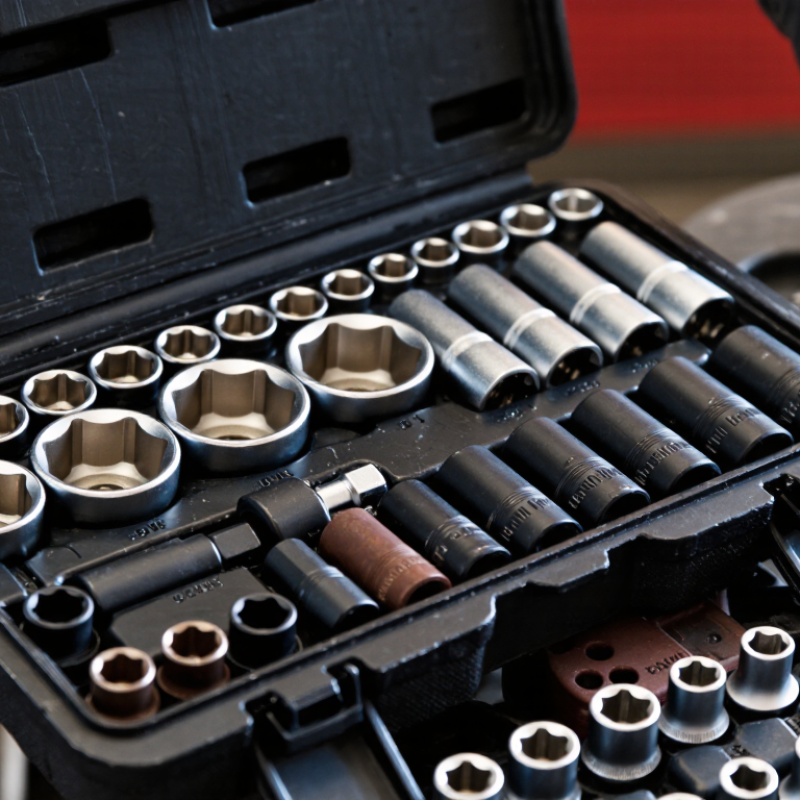
A car repair socket set is a group of interchangeable tools for loosening and tightening nuts and bolts. It usually includes sockets, a ratchet handle, extensions, and adapters. The sockets fit over fasteners more securely than many open-ended wrenches. This reduces slipping and protects the corners of the bolt.
In practical repairs, socket size matters greatly. A small mismatch can damage a fastener, especially on rusted suspension parts. Fit comes first. A dependable set should offer common metric sizes, clear markings, and a firm ratchet mechanism. Six-point sockets often provide better contact for stubborn bolts. Deep sockets help reach nuts on long threaded studs. Extensions are useful around cramped engine compartments.
Material quality also affects safety and service life. Hardened steel can resist repeated workshop pressure, but no socket is indestructible. Check for cracks, rounded edges, or a loose ratchet before use. I once chose a convenient shallow socket for a recessed fastener and wasted time repositioning it. That mistake was simple, but avoidable. A torque wrench is still necessary when a repair requires a specified tightening value. A socket set only transfers force; it does not measure it. Clean tools after greasy work, store them by size, and avoid using a ratchet as a hammer. Some sets appear impressive because they contain many pieces, yet several may be rarely useful. Choosing practical coverage is often wiser than chasing the largest box.
Choosing a car repair socket set starts with the fastener, not the toolbox. The U.S. Bureau of Labor Statistics projects about 80,000 annual openings for automotive service technicians through 2033. That workload demands accurate size matching and durable drive systems. Check whether the vehicle uses metric or imperial fasteners. Many modern vehicles mainly use metric sizes, but mixed sets remain practical for older repairs.
Use a 1/4-inch drive for small clamps, trim bolts, and low-torque sensors. A 3/8-inch drive handles common engine and suspension work. Choose a 1/2-inch drive for wheel nuts and heavily tightened chassis fasteners. Six-point sockets grip bolt flats better and reduce rounding. Twelve-point sockets offer easier alignment in tight spaces. I still misjudge this sometimes. A deep socket may reach a recessed nut, but it can obstruct nearby parts.
Match socket construction to the tool. Hand sockets suit ratchets and torque wrenches. Impact sockets require stronger materials and suitable markings. Never assume a regular socket is safe for powered impact use. ISO 1174-1 defines drive-interface dimensions, while ASME B107.1 covers socket performance requirements. These standards help verify compatibility, but they cannot replace torque specifications from service documentation. A 2024 aftermarket workforce report from the Auto Care Association also highlights technician shortages, making efficient tool selection increasingly important. Test fit before applying force. Small details matter.
Choosing a car repair socket set starts with material, not the number of pieces. Chrome vanadium steel suits common repair work because it balances hardness, toughness, and corrosion resistance. Chrome molybdenum steel is better for impact sockets and high-torque applications. It absorbs shock more reliably. I have seen cheap sockets crack around the drive square after repeated use. The failure often began with poor heat treatment, not thin walls.
Manufacturing details reveal more than polished surfaces. Cold forging should create a dense grain structure. Precision broaching helps the socket grip fasteners evenly. A six-point profile usually reduces corner damage on stubborn nuts. Look for controlled hardness, clear size markings, and a smooth chamfer at the opening. ISO 1174-1 defines important drive-square dimensions, while ASME B107 socket-tool requirements support dimensional and performance checks. These references matter during supplier evaluation. They do not replace physical testing.
Market data also explains the pressure behind quality claims. Grand View Research estimated the global hand tools market at about 23 billion dollars in 2023, with continued growth expected through 2030. That growth can encourage volume production, sometimes too quickly. Ask for torque-test records, hardness results, and corrosion-test conditions. Salt-spray hours alone can mislead. I once judged a set by its mirror finish. That was a mistake. A reliable set should maintain fit after repeated torque cycles, not merely look bright on a showroom shelf.
Material hardness and manufacturing method strongly affect socket durability, wear resistance, and safety. The chart shows representative hardness ranges commonly used for different socket materials.
Cr-V is commonly selected for standard hand sockets because it balances toughness and wear resistance. Cr-Mo is preferred for impact sockets because its lower hardness and higher toughness help absorb repeated shock loads. S2 steel is typically used for bit-socket inserts, where higher hardness improves resistance to twisting and edge wear. For overall quality, also look for cold forging, controlled heat treatment, precise six-point broaching, accurate drive dimensions, clear markings, and corrosion-resistant surface protection.
A reliable socket set starts with a verifiable supplier, not a polished catalog. Check factory experience, production photos, inspection procedures, and export records. Ask for certificates with issuing bodies, scope, and valid dates. ISO 9001 can show quality management, but it does not prove every socket meets performance requirements. Request material reports and hardness results for the actual batch. Independent testing is more convincing than a scanned certificate.
Tips: Order samples before bulk production. Test drive fit, wall thickness, chrome finish, and ratchet movement. Use a torque tester if possible. Confirm whether measurements follow metric or imperial standards. Ask how defects are recorded and replaced. Small details matter.
Custom options can include drive sizes, socket depth, surface finish, laser markings, foam trays, and retail packaging. Put every specification into a signed document. Include tolerance ranges, logo artwork, packing quantity, and inspection rules. A supplier may promise flexibility, yet tooling costs and minimum order quantities can change the final price. Ask for a production sample, not only a digital drawing. In one workshop evaluation, a socket looked accurate but fitted poorly because the internal corner was too sharp. That mistake was easy to miss. Recheck samples under real working conditions. A short trial can reveal more than a long sales presentation.
Choosing the best car repair socket set from China requires more than comparing the lowest price. I check the steel specification, socket markings, ratchet movement, and case strength. A cheap kit may look complete, yet missing deep sockets or extension bars can create extra costs later. Count every useful piece. Not the printed number.
Compare kits by working coverage, not quantity alone. A practical set should include common metric sizes, deep sockets, adapters, universal joints, and a reliable torque range. I test the ratchet under controlled workshop conditions and inspect whether its teeth slip. Small details matter. Smooth release helps.
Warranty terms reveal the seller’s confidence. Check coverage length, proof requirements, replacement procedures, and shipping responsibility. Some warranties sound generous but exclude worn ratchets, damaged cases, or ordinary workshop use. Ask for written details before purchasing. I once chose a cheaper set with a vague warranty, and replacing one failed tool erased the savings. That mistake still influences my comparisons.
Long-term value depends on corrosion resistance, replacement availability, and comfort during repeated repairs. A slightly higher price can be reasonable when sockets fit fasteners accurately and resist rounding. Still, expensive does not always mean dependable. Read independent user reports, examine close-up photographs, and compare the total cost over several years. Leave room for doubt. Tools deserve careful judgment.
A practical comparison of common unbranded socket-set specifications for vehicle repair and maintenance
| Comparison Dimension | Entry-Level Set | General Repair Set | Professional Workshop Set | Heavy-Duty / Impact Set | What to Check Before Buying |
|---|---|---|---|---|---|
| Typical Set Size | 40–60 pieces | 90–120 pieces | 150–220 pieces | 45–100 pieces | Piece counts may include adapters, extensions, bits, and duplicate sizes. Compare the actual usable sockets rather than the total number alone. |
| Common Drive Sizes | 1/4 in and 3/8 in | 1/4 in, 3/8 in, and 1/2 in | 1/4 in, 3/8 in, and 1/2 in; some sets add 3/4 in | 3/8 in, 1/2 in, and sometimes 3/4 in | For most passenger vehicles, 1/4 in, 3/8 in, and 1/2 in drives cover a broad range of fasteners. |
| Typical Socket Range | Approximately 4–19 mm | Approximately 4–32 mm | Approximately 4–36 mm | Approximately 8–46 mm | Check whether the set includes metric sizes, inch sizes, deep sockets, spark-plug sockets, and thin-wall sockets where required. |
| Material and Finish | Chrome-vanadium steel with polished chrome finish | Chrome-vanadium steel with corrosion-resistant chrome finish | Heat-treated chrome-vanadium steel; selected impact pieces may use chrome-molybdenum steel | Impact-grade chrome-molybdenum or comparable alloy steel with a black phosphate finish | Chrome sockets are intended for hand tools. Impact sockets should be used with impact tools; do not substitute standard chrome sockets. |
| Ratchet Mechanism | 72-tooth or lower-tooth ratchet, usually reversible | 72-tooth reversible ratchet is common | 72-tooth or fine-tooth reversible ratchets, often with multiple handles | Impact tools are usually separate; included ratchets may be heavy-duty hand-tool types | A finer tooth count provides a smaller swing arc, which is useful in confined engine-bay spaces. Inspect selector feel and back-drag. |
| Approximate China Export Price Range | US$10–25 per set | US$25–70 per set | US$70–180 per set | US$45–160 per set | Indicative bulk or factory-level ranges only. Final pricing changes with steel grade, testing, packaging, order quantity, customization, freight, and duties. |
| Best Use Case | Basic home maintenance, motorcycles, and occasional repairs | Routine passenger-car servicing and general mechanical work | Daily workshop use, fleet maintenance, and broader vehicle coverage | Rusty, seized, high-torque, truck, suspension, and wheel-related fasteners | Choose the set according to torque requirements and frequency of use rather than the highest piece count. |
| Deep Socket Coverage | Limited; often only selected sizes | Usually includes common metric deep sockets | Broad deep-socket coverage across major drive sizes | Commonly includes deep impact sockets in medium and large sizes | Deep sockets are useful for long studs and recessed nuts. Confirm the exact sizes supplied instead of relying on product photographs. |
| Useful Accessories | Extensions, universal joint, screwdriver bits, and adapter | Extensions, universal joints, bit sockets, spark-plug sockets, and breaker-bar support | Multiple extensions, universal joints, bit sets, breaker bar, and storage case | Impact extensions, impact universal joints, adapters, and heavy-duty storage | Impact accessories must be impact-rated. A standard adapter or extension may fail under powered impact use. |
| Storage and Portability | Plastic case; lightweight and compact | Molded case with labeled slots | Reinforced case, metal box, or modular storage system | Heavy-duty case; higher shipping weight and space requirement | Check latch strength, socket retention, label durability, and whether the case protects tools during international transport. |
| Typical Warranty Offered | 6–12 months limited warranty | 12–24 months limited warranty | 24–60 months limited warranty, depending on the supplier agreement | 12–36 months limited warranty; impact accessories may have separate terms | Ask whether coverage includes manufacturing defects only, replacement freight, individual missing pieces, rust, and misuse exclusions. |
| Quality-Control Documents to Request | Basic dimensional inspection and packing checklist | Material declaration, hardness records, and sampling inspection | Material certificates, torque or load testing, dimensional records, and batch inspection | Impact-performance testing, hardness records, dimensional inspection, and batch traceability | Request dated inspection records and confirm that the documents apply to the exact production batch and socket sizes. |
| Common Long-Term Risk | Loose ratchet mechanism, rounded corners, plating wear, or missing pieces | Uneven heat treatment, case damage, or inconsistent size marking | Replacement difficulty, case wear, and variation between production batches | Cracking from incorrect use, wrong material grade, or insufficient impact testing | Sample testing before a large order is usually more valuable than comparing catalog photographs alone. |
| Best Value Choice | Suitable only when purchase price is the main priority | Best for most vehicle owners Good balance of coverage, price, and portability |
Best for frequent professional use Higher initial cost with broader coverage and stronger support |
Best for high-torque work Worth the premium when impact tools are used regularly |
For general automotive maintenance, prioritize complete metric coverage, reliable ratchets, deep sockets, clear warranty terms, and replacement availability. |
| Long-Term Value Indicators | Low purchase cost and low replacement cost | Balanced durability, broad coverage, and manageable replacement needs | Higher durability, better ergonomics, documented quality control, and spare-piece support | Reduced risk of tool failure during high-load work and better suitability for demanding repairs | Estimate total cost of ownership: purchase price + freight + duties + replacement pieces + downtime + warranty handling. |
Price note: The price ranges are general indicative ranges for unbranded products supplied from China and are not fixed quotations. Always confirm specifications, test samples, packaging, warranty coverage, and delivered cost before placing an order.
It contains interchangeable sockets, a ratchet handle, extensions, and adapters. Sockets fit over nuts and bolts. They can reduce slipping and protect fastener corners.
The socket must match the fastener precisely. A small mismatch may damage a bolt, especially on rusty suspension parts. Test the fit before applying force.
A 1/4-inch drive suits small clamps, trim bolts, and low-torque sensors. A 3/8-inch drive handles common engine and suspension repairs. A 1/2-inch drive suits wheel nuts and tight chassis fasteners. These are useful guidelines, not perfect rules.
Six-point sockets grip bolt flats more securely. They help reduce rounding on stubborn fasteners. Twelve-point sockets align more easily in cramped spaces. I still misjudge this sometimes.
A deep socket reaches nuts on long threaded studs. It also helps with recessed fasteners. However, it may contact nearby engine parts. Check the clearance carefully.
No. Hand sockets suit ratchets and torque wrenches. Impact tools require sockets designed for repeated powered force. Never assume a regular socket is suitable. That assumption can end badly.
No. A socket set only transfers force. A torque wrench measures and applies a specified tightening value. Hand-feel is not precise enough for every repair. Small differences matter.
Check for cracks, rounded edges, and a loose ratchet before use. Clean greasy tools after repairs. Store them by size. Never use a ratchet as a hammer.
Not necessarily. Some large sets contain rarely used pieces. Practical metric coverage may be more useful. Include common sizes, clear markings, and firm ratchet action. More pieces can create clutter.
Choosing a car repair socket set requires more than counting the number of pieces in the case. First, consider the repairs you normally perform and select a kit with the appropriate metric or imperial sizes, socket types, and drive systems. Deep sockets can reach recessed fasteners, while impact-rated sockets are better for high-torque tools. Compatibility with your ratchets, extensions, torque wrenches, and vehicle requirements is also essential. Understanding how to choose the right socket set for car repair helps prevent slipping, damaged fasteners, and unnecessary purchases.
Quality depends on durable materials, accurate machining, clear size markings, corrosion resistance, and secure storage. When evaluating suppliers, review production capability, inspection procedures, certifications relevant to your market, customization options, packaging, warranty terms, and after-sales support. Price should be compared with the kit’s completeness, expected service life, replacement availability, and overall reliability rather than judged alone. A well-selected set may cost more initially but can deliver better long-term value through safer work, fewer replacements, and consistent performance.
